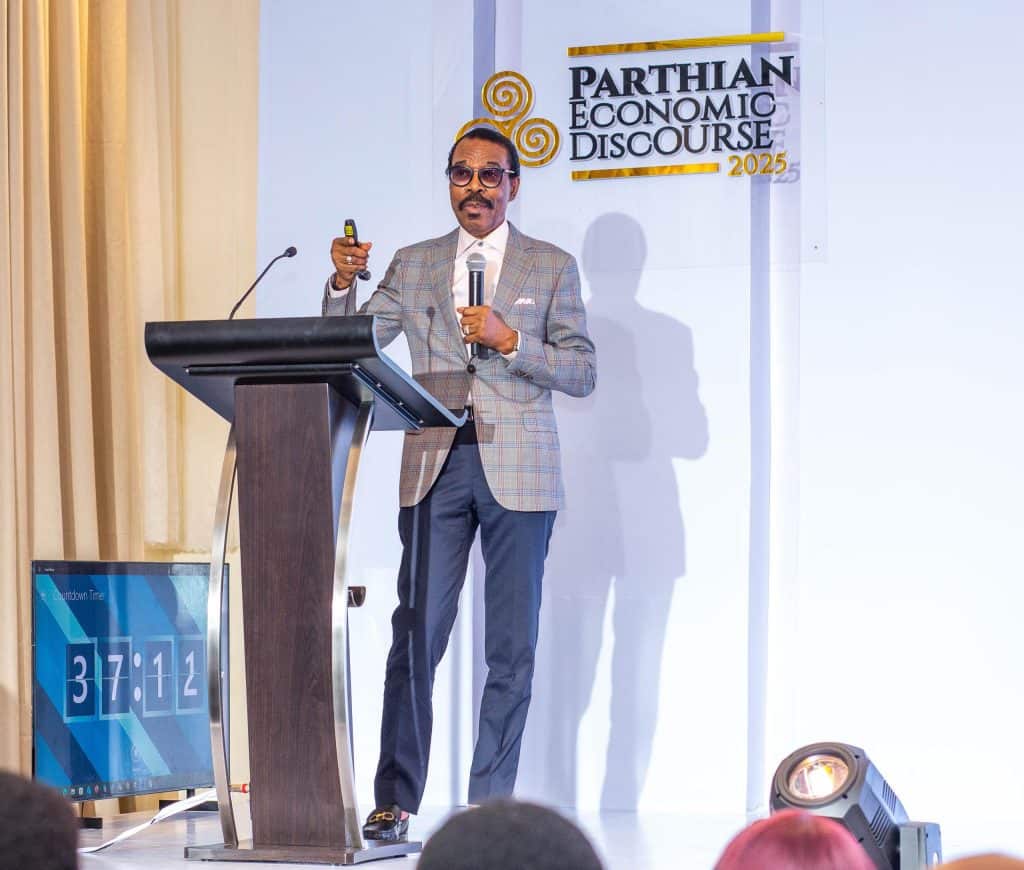
LAGOS, NIGERIA – November 27, 2025 – The 2025 Parthian Economic Discourse (PED25), convened today by Parthian Partners, brought together Nigeria’s leading economic minds to chart the path from policy reforms to tangible economic results. Under the theme “Reforms to Results: Powering Economic Growth for Shared Prosperity,” speakers emphasized that 2026 will be a pivotal year for institutional deepening, market expansion, and domestic capital mobilization.
Bismarck Rewane, Non-Executive Director at Parthian Partners and Managing Director of Financial Derivatives Company, headlined the event with a bullish forecast for the capital market, projecting that market capitalization would climb to N262 trillion in 2026.
“Market cap to climb to N262trn in 2026 due to new listings, earnings, and efficiency,” Rewane stated, signaling a robust recovery driven by corporate performance rather than just sentiment. However, he cautioned that the success of these projections relies heavily on how institutions manage the economic environment.
“Reform does not just mean policy change but includes institutional reforms and market response,” Rewane said. He stressed the importance of discernment in the coming year, noting, “Outlook is not as important as the judgement. What you do with information is the most important thing.”
Rewane also highlighted the critical nature of government spending transparency. “The quantum of government expenditure is not as important as its dominance. What you see is what you get, what you don’t see is what gets you,” he warned.

Tax Reforms to Boost Disposable Income
Taiwo Oyedele, Chairman of the Presidential Committee on Fiscal Policy and Tax Reforms, used the platform to clarify the impact of the ongoing tax overhaul on the average Nigerian. He assured stakeholders that the reforms are designed to be progressive and pro-people.
“98% of Nigerians will see an improvement in disposable income because taxes will reduce,” Oyedele declared, explaining that the new framework shifts the burden away from the vulnerable. “The tax reform is to make the tax system in Nigeria progressive.”
Addressing concerns about the Capital Gains Tax (CGT), Oyedele offered a strategic perspective on the proposed adjustments. “The 30% CGT in 2026 is better than the 10% currently. This is because the 10% has risk attached to it while the 30% discounts the risk,” he argued, suggesting that the new regime offers greater certainty for investors to “incentivize investors to stay longer.”
Sequencing Reforms and the Human Capital Crisis
Ireti Samuel-Ogbu, Chair of the Board at the Africa Finance Corporation (AFC), called for a more structured approach to policy implementation and a renewed focus on human capital. She observed that while the intent of recent policies was sound, the execution required better timing.
“The reforms have been good but it could have been better sequenced to make sure that there was supply, Naira is stable then subsidy is removed,” Samuel-Ogbu stated. She stressed that policies must “deliver tangible benefits” and positively impact the population in areas such as “inflation control, education, transportation, and overall quality of life.”
Beyond macro-sequencing, Samuel-Ogbu raised an alarm regarding the widening skills gap in the country. “Education and digital skills gaps are huge. Over 18 million Nigerian children are out of school, and among those in school, 85% lack digital literacy,” she revealed. She warned that even graduates often lack the capacity to function in a digital economy, urging that policy planning must consider population dynamics to truly consolidate economic gains.
“Nigeria must expand beyond oil-dependent revenue, exploring non-oil sources of income to strengthen the economy,” she concluded.
Pension Assets to Hit N30trn: A Pillar for Real Sector Growth
Olufemi Odukoya, Managing Director of Parthian Pensions, highlighted the explosive growth of the pension industry as a testament to the power of domestic capital formation. He traced the sector’s transformation from a deficit of N2.4 trillion in unpaid liabilities in 2004 to over N26 trillion in assets today.
“Pensions are fully tax-exempt, and that remains one of the key advantages of our system,” Odukoya noted. He projected further growth, stating that assets are expected to hit “N30 trillion next year, adding N4 trillion in domestic capital.”
Odukoya emphasized that these funds are not idle but are actively powering the real economy. “Across energy, power, infrastructure, and agriculture, investments are being funded through locally mobilized capital, and that is the real impact of the pension industry,” he said.
He also commended recent regulatory bold steps, such as increasing infrastructure fund limits to 25% for Fund I and introducing new asset classes like agricultural investment funds. “All of this signals one thing: the government clearly recognizes the role pension assets play in driving economic growth,” Odukoya added.
Now in its third year, the Parthian Economic Discourse (PED) has established itself as an important annual event organised by Parthian Group. The event reflects Parthian’s ongoing commitment to providing value-added services to its clients and stakeholders. It serves as a crucial platform for businesses, investors, and policymakers, offering strategic guidance and insights into Nigeria’s evolving macroeconomic landscape.