CBN Holds MPR at 23.0% as Disinflation Continues and Policy Transmission Improves
The Central Bank of Nigeria’s Monetary Policy Committee (MPC) retained the Monetary Policy Rate (MPR) at 23.00% and maintained all other monetary policy parameters at its final meeting of the year, signaling a preference for policy stability as disinflation progresses. The decision reflects the Committee’s efforts to consolidate the disinflationary gains amid sustained exchange rate stability and improving monetary policy transmission, while remaining cautious of emerging inflationary risks. Although headline inflation declined for the fifth consecutive month to 14.06% in October, seasonal spending and election-related expenditure could slow the disinflationary trajectory, reinforcing the need to maintain the current policy stance to anchor inflation expectations.
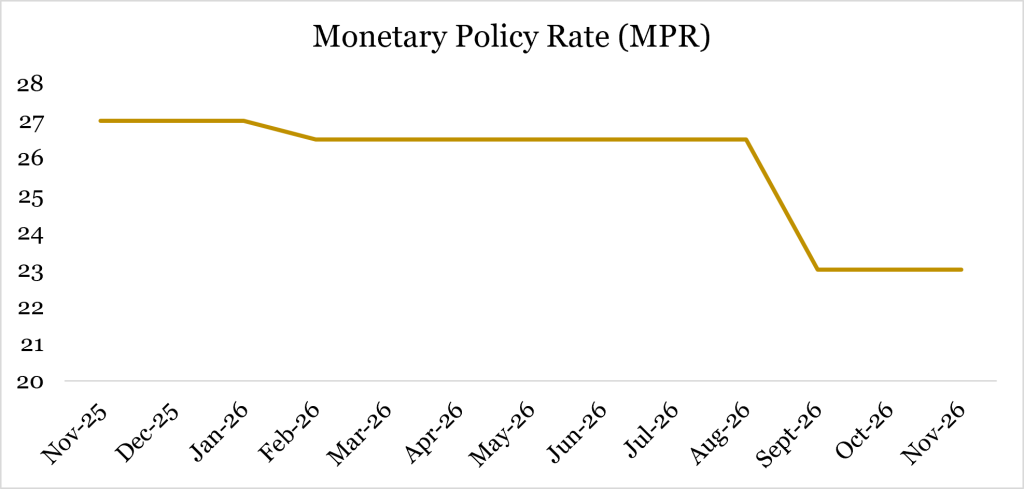
September recalibration improves monetary policy transmission
The CBN Governor noted that the September recalibration of the MPR to 23.00% is yielding the intended outcomes, with interbank rates (average of 20.25%) moving closer to the lower end of the standing facility corridor (20%), while OMO and Treasury bills yield moderate. The narrowing gap between the policy rate and prevailing market rates suggests that the reset is gradually restoring the MPR’s influence on market pricing and improving monetary policy transmission.
Private-sector credit is also showing signs of recovery (increased by 15.7% to N83.93trn in September 2026), although lending costs remain elevated. This indicates that the adjustment is beginning to influence market rates and credit conditions, but transmission to borrowing costs and real economic activity remains gradual. Maintaining the current policy settings should therefore allow these adjustments to deepen while preserving the restrictive conditions required to sustain disinflation.
Economic and market implications
- Fixed Income: Moderating OMO and Treasury bill rates could sustain downward pressure on short-term yields. However, repricing will remain sensitive to system liquidity, government borrowing and inflation expectations. Investors may continue to prioritise attractive carry while selectively positioning for potential capital gains.
- Equities: Disinflation and exchange rate stability could improve earnings visibility and investor sentiment. However, elevated interest rates and funding costs may constrain the pace of recovery, favouring companies with resilient earnings, strong cash flows and manageable leverage.
- Banking: Gradual private-sector credit recovery could support core intermediation income. However, lower money market yields may moderate treasury income, increasing the importance of funding costs, asset quality and sustainable loan growth.
Exchange rate stability and external buffers support the outlook
Despite recent FX market volatility and a modest reserve decline, the CBN maintained confidence in Nigeria’s external position. Gross external reserves stood at US$54.02bn as of November 17, 2026, equivalent to 10.26 months of import cover. The Governor attributed recent volatility partly to seasonal portfolio rebalancing, domestic hedging demand ahead of the new year and increased election-related spending, which is expected to moderate in the coming year.
Sustained current account surpluses and strong diaspora remittances, which approached US$900m in the preceding month, provide additional support to the external position. The proposed Memorandum of Understanding between the CBN and NNPC is also expected to improve coordination and transparency around oil-sector FX flows. Effective implementation could strengthen FX liquidity, support reserve accretion and reinforce exchange rate stability, although the impact will depend on actual delivery.
Outlook
The MPC’s decision underscores its preference for policy consistency as the CBN consolidates disinflation gains and strengthens monetary policy transmission. Improving inflation dynamics, exchange rate stability and external buffers provide a supportive backdrop, but energy-price risks, seasonal demand and election-related spending remain potential sources of inflationary pressure. Monetary policy is therefore likely to remain data-dependent, with the CBN prioritizing price stability while allowing the September policy reset to transmit more fully to market rates and credit conditions.