Inflation Rises Further, but MoM Trends Suggest Emerging Price Stabilization
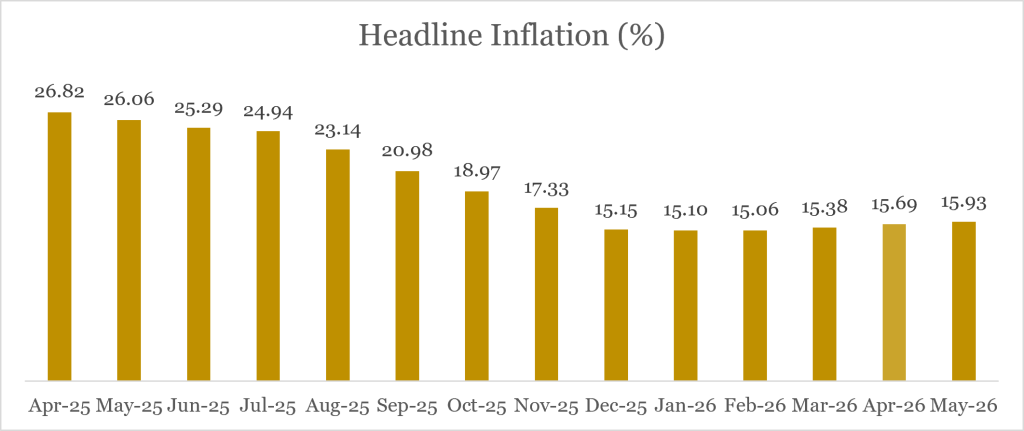
In line with expectations, Nigeria’s inflation rate maintained its upward trajectory in May, with headline inflation rising for the third consecutive month to 15.93% year-on-year, from 15.69% in April, according to data from the National Bureau of Statistics (NBS). The continued increase largely reflects lingering base effects from the earlier global energy shock triggered by tensions in the Middle East.
However, month-on-month inflation moderated to 1.75% from 2.13% in April, indicating some easing in sequential price pressures. While this suggests that the pass-through effects of earlier energy shocks may be gradually moderating, the 0.96% increase in core inflation to 16.82% indicates that underlying inflationary pressures remain elevated.
Inflation Breakdown
Food Inflation Accelerates to 16.96%
Food inflation rose to 16.96% year-on-year in May, from 16.06% in April, driven partly by base effects and worsening security concerns across key agricultural regions. However, the month-on-month reading moderated to 2.98% from 3.63%, despite the festive demand associated with Eid al-Adha. This suggests that weak consumer purchasing power is suppressing demand conditions and limiting producers’ ability to fully pass higher input costs to consumers.
Core Inflation Edges Higher to 16.82%
Core inflation increased to 16.82% year-on-year in May, from 15.86% in April, while the month-on-month print accelerated to 1.94% from 1.03%. The increase highlights continued stickiness across non-food price components, particularly within housing, healthcare, and other services-related categories.
Outlook — Can the MoM Easing Be Sustained?
The moderation in month-on-month inflation suggests that underlying price pressures may gradually soften in the near term, although the inflation outlook remains mixed.
On the positive side, easing geopolitical tensions following the ceasefire between the United States and Iran have contributed to lower global crude oil prices, reducing concerns around energy-driven inflation. Sustained moderation in international oil prices would filter through to lower domestic Premium Motor Spirit (PMS) prices over time, easing transportation, logistics, and production costs. Combined with relative exchange-rate stability and still-fragile consumer demand, this could support a gradual moderation in headline inflation over the coming months.
However, upside risks remain significant and continue to be concentrated in food inflation. Overlaying the potential gains from lower energy prices is the deteriorating security situation across Nigeria’s major agricultural belts. Sustained banditry and insurgent activity across the North West and North East, including states such as Zamfara, Kebbi, Katsina, Borno, and Adamawa has constrained farming activity, reduced access to cultivated land, and disrupted the movement of agricultural produce to consumption centres.
In addition, the gradual build-up to the 2027 election cycle presents an additional source of inflation risk. Historically, pre-election periods have been associated with increased fiscal spending and liquidity injections, which could mount inflationary pressures if not matched by productivity gains.
Implication for MPC
For the Monetary Policy Committee (MPC), the May inflation print presents a more balanced policy picture. While the moderation in month-on-month inflation and relative exchange-rate stability provide some encouragement, the continued acceleration in both headline and core inflation suggests that underlying inflationary pressures remain significant. Consequently, the MPC is likely to retain a cautious stance until a more sustained moderation in price pressures becomes evident.