Inflation is Projected to Ease to 15.70% in July
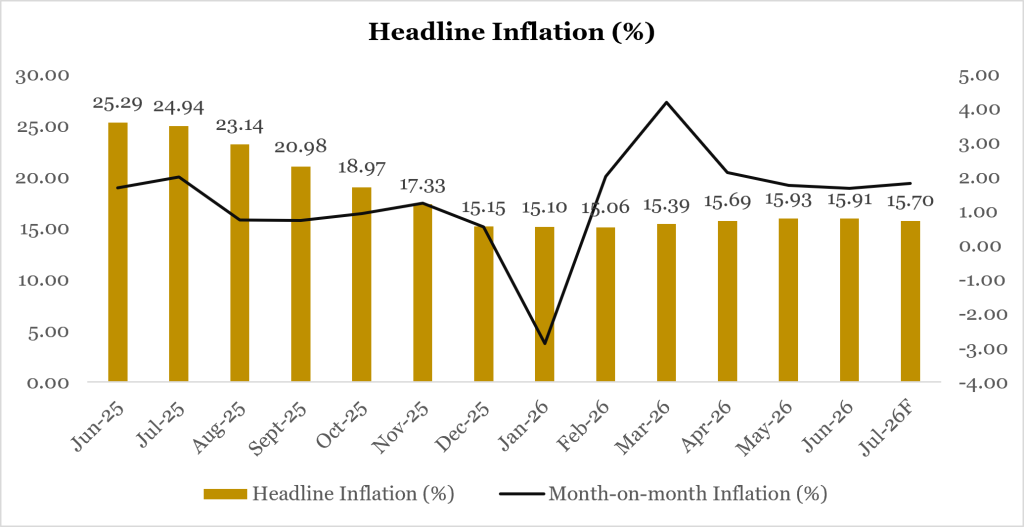
The National Bureau of Statistics (NBS) is scheduled to release Nigeria’s July 2026 Consumer Price Index (CPI) and inflation report on August 15. Based on our model, headline inflation is projected to moderate further to 15.70% year-on-year from 15.91% in June. If directionally correct, it would mark the second consecutive monthly decline, supported by continued exchange rate stability, lower energy prices relative to the peak recorded during the Middle East crisis in Q2’26, and improving food supply as the harvest season gathers momentum.
Despite the expected decline in annual inflation, our model points to an acceleration in month-on-month inflation to 1.81% from 1.66% in June, largely reflecting higher PMS prices following the resurgence of the Middle East crisis. After the June ceasefire agreement, crude oil prices fell towards $70 per barrel, prompting a reduction in Dangote Refinery’s PMS gantry price to ₦1,075/litre. However, the subsequent escalation in the conflict pushed crude prices back towards the $80–$90 per barrel range, resulting in an upward adjustment in the gantry price to ₦1,215/litre towards the end of July. The resulting increase in transportation and logistics costs is expected to exert upward pressure on monthly inflation.
Looking ahead, relative stability in global oil prices should provide some support for monthly inflation in the coming month. Already, the Dangote Refinery has revised the gantry price downward by 4.12% to ₦1,165/litre so far in August. This, alongside continued exchange rate stability and improving food supply as the harvest season progresses, should help ease monthly price pressures. The key upside risk remains a renewed escalation in the Middle East crisis, which could lead to a sharp increase in global energy prices.
Policy Outlook
The MPC is scheduled to meet next month, with July and August inflation data critical to its decision. While headline inflation is expected to moderate in July, the sustainability of the trend in August and the direction of month-on-month inflation will be key, with the Committee likely to place greater emphasis on monthly price pressures as a more timely indicator.
The outcome of the US Fed meeting, scheduled about a week before the Nigerian MPC meeting, will also be an important consideration. The Fed maintained its policy rate at 3.50%–3.75% in July, although three members voted for a 25bps hike, reflecting concerns over inflation remaining above target. Meanwhile, July data showed a decline in unemployment to 4.1%, alongside lower labour-force participation and subdued jobless claims, suggesting some softening in labour market conditions. However, with inflation still elevated, the Fed may have limited scope for aggressive easing, opting to continue with its wait and see approach. This could keep global yields elevated.
Hence, we expect the CBN to retain the MPR at 26.5% in September, pending clearer evidence of sustained moderation in domestic price pressures.