Inflation Projected to Remain Relatively Flat at 15.42% in August
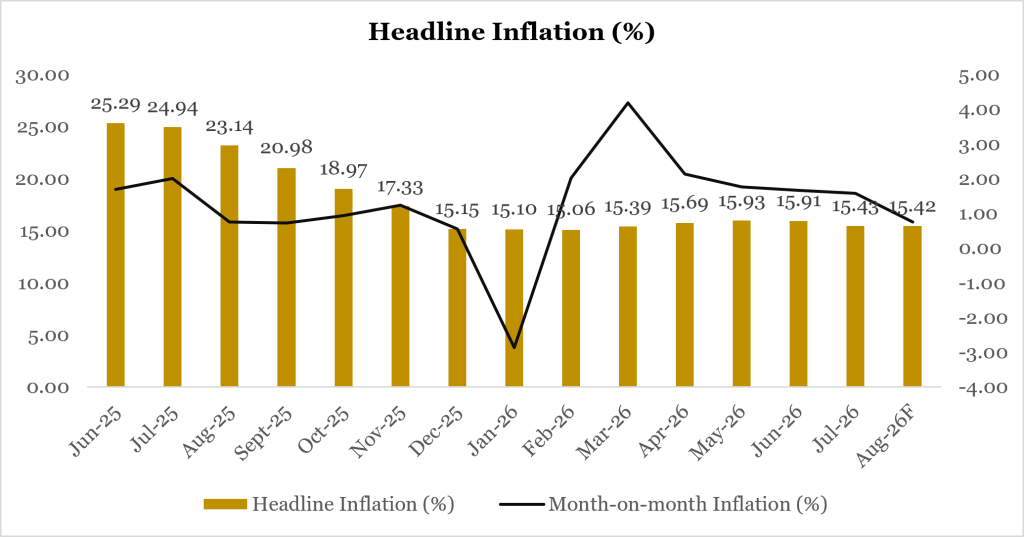
The Consumer Price Index (CPI) and inflation report for August 2026 is scheduled for release by the National Bureau of Statistics (NBS) on September 15, 2026. According to our model, headline inflation is projected to remain relatively flat at 15.42% (year-on-year) in August, compared with 15.43% in July. Meanwhile, month-on-month inflation is expected to decline sharply to 0.74% from 1.57% in July.
The significant moderation in month-on-month inflation was supported by naira stability and improved food supply during the harvest season. The naira appreciated by 2.65% in August to ₦1,332.94/$, helping to contain imported inflation and input costs, while increased agricultural supply eased food-price pressures.
Meanwhile, the recent PMS price increases had a limited impact on August inflation, as the adjustments occurred towards the end of the month. Consequently, the full impact is more likely to emerge in September, particularly through higher transportation and distribution costs.
Outlook and Monetary Policy
Although August inflation is projected to remain relatively flat, the inflation outlook is increasingly tilting to the upside, driven by the renewed escalation of the Middle East crisis and its potential impact on crude oil prices, PMS prices, transportation and logistics costs. However, continued naira stability and improved food supply during the harvest season should help moderate the pace of price increases.
With headline inflation expected to flatten after two consecutive months of decline, the renewed external energy-price shock raises concerns over a possible reversal in the disinflationary trend. We therefore expect the MPC to maintain a hawkish stance, with a hold likely at the September meeting as the Committee assesses the persistence and transmission of the latest inflationary pressures. However, a sustained increase in inflation could increase the likelihood of tighter monetary policy at the November meeting.
Inflation Projected to Remain Relatively Flat at 15.42% in August
The Consumer Price Index (CPI) and inflation report for August 2026 is scheduled for release by the National Bureau of Statistics (NBS) on September 15, 2026. According to our model, headline inflation is projected to remain relatively flat at 15.42% (year-on-year) in August, compared with 15.43% in July. Meanwhile, month-on-month inflation is expected to decline sharply to 0.74% from 1.57% in July.
The significant moderation in month-on-month inflation was supported by naira stability and improved food supply during the harvest season. The naira appreciated by 2.65% in August to ₦1,332.94/$, helping to contain imported inflation and input costs, while increased agricultural supply eased food-price pressures.
Meanwhile, the recent PMS price increases had a limited impact on August inflation, as the adjustments occurred towards the end of the month. Consequently, the full impact is more likely to emerge in September, particularly through higher transportation and distribution costs.
Outlook and Monetary Policy
Although August inflation is projected to remain relatively flat, the inflation outlook is increasingly tilting to the upside, driven by the renewed escalation of the Middle East crisis and its potential impact on crude oil prices, PMS prices, transportation and logistics costs. However, continued naira stability and improved food supply during the harvest season should help moderate the pace of price increases.
With headline inflation expected to flatten after two consecutive months of decline, the renewed external energy-price shock raises concerns over a possible reversal in the disinflationary trend. We therefore expect the MPC to maintain a hawkish stance, with a hold likely at the September meeting as the Committee assesses the persistence and transmission of the latest inflationary pressures. However, a sustained increase in inflation could increase the likelihood of tighter monetary policy at the November meeting.