Inflation Eases Slightly to 15.39% but Upside Risks Build
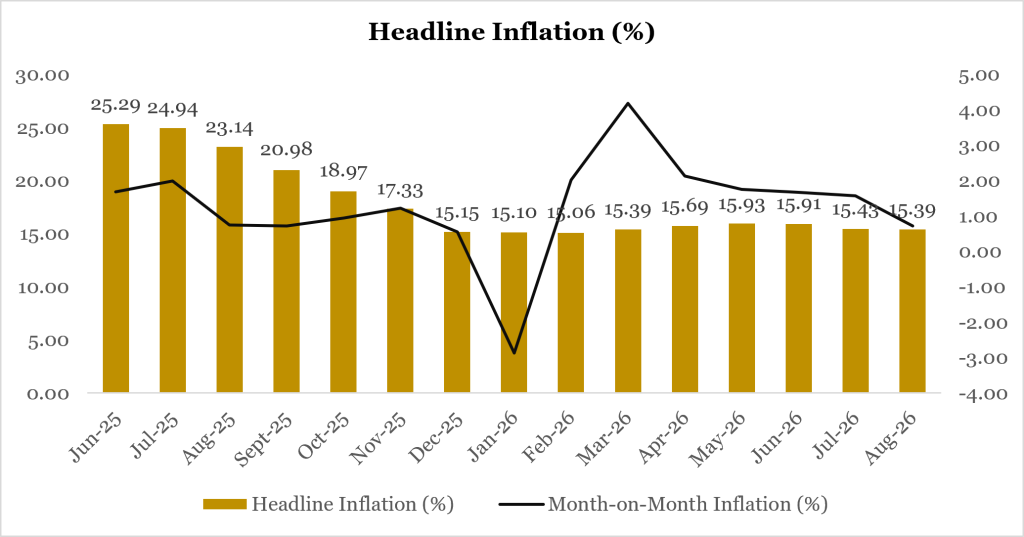
Nigeria’s headline inflation eased marginally to 15.39% (year-on-year) in August 2026 from 15.43% in July (slightly below our 15.42% forecast), marking the third consecutive monthly decline. More importantly, month-on-month inflation fell sharply to 0.71% from 1.57%, signaling a significant moderation in the pace of price increases.
The moderation was evident across key components, with food inflation easing to 19.57% from 20.31%, while core inflation declined to 13.29% from 14.97%. On a monthly basis, food inflation fell to 1.02% from 5.56%, while core inflation turned negative at -0.06%, indicating softer underlying price pressures.
Harvest Season and Exchange Rate Stability Support Disinflation
Improved food supply during the harvest season and relative naira stability supported the August moderation. The naira appreciated 2.65% to ₦1,332.94/$, helping to contain imported inflation and supporting the decline in core inflation.
Inflation Outlook Tilts to the Upside
Despite the continued decline in headline inflation, the outlook is increasingly tilted to the upside. The resurgence of the Middle East crisis poses a key risk through higher global crude prices and potential pass-through to domestic PMS, transport and logistics costs. The Dangote Refinery has already increased PMS gantry prices four times between 21 August and 12 September, by a cumulative ₦185/litre (representing an increase of 15.90%).
While naira stability and improved food supply should provide some offset, sustained energy-price pressures could generate second-round effects and slow the disinflationary process.
Monetary Policy: Cautious Hold Remains Likely
The August data provides some support for the CBN’s disinflation narrative, particularly given the sharp moderation in month-on-month and core inflation. However, the flattening headline trajectory and emerging energy-price risks reinforce the case for caution.
We expect the MPC to maintain its current policy stance and monitor the persistence of disinflation alongside energy-price pass-through. The next two months of monthly inflation data will be critical in determining whether the recent moderation is sustained or reversed by renewed cost pressures.