Inflation Likely to Sustain its Downward Trend in September
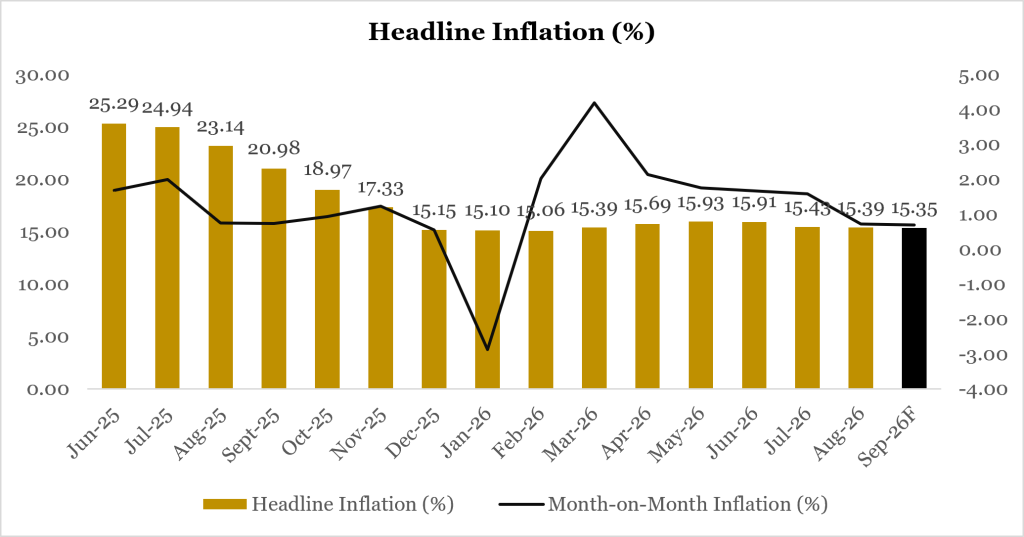
Nigeria’s headline inflation is projected to ease marginally to 15.35% (year-on-year) in September 2026 from 15.39% in August. If accurate, it would mark the fourth consecutive monthly decline and a six-month low. Month-on-month inflation is also expected to moderate to 0.68% from 0.71%, indicating a slower pace of price increases.
The anticipated moderation largely reflects seasonal improvements in food supply and relative exchange-rate stability. The Naira appreciated by 0.28% to ₦1,329.16/$ in September. However, higher petrol prices remain an upside risk. The Dangote Petroleum Refinery raised its gantry price by ₦85 (6.72%) to ₦1,350/litre on September 12, although it reduced it slightly by ₦25 to ₦1,325/litre on September 22. Higher energy prices could sustain pressure on transportation, distribution and production costs.
Likely Policy Response
The anticipated marginal decline may reinforce the case for a measured approach by the Central Bank of Nigeria (CBN). Following the recent reset of the Monetary Policy Rate to 23.0% from 26.5%, the Monetary Policy Committee is likely to assess the September inflation data alongside monthly price trends, exchange-rate stability, inflation expectations and the transmission of its latest policy adjustments. A single, modest decline may not be sufficient to justify further policy recalibration, particularly while fuel-price increases pose a risk to the disinflationary trajectory.
Outlook
Inflation risks remain tilted to the upside, as elevated petrol prices could sustain cost pressures across the supply chain. The Federal Government’s 30-day PMS discount window may provide temporary relief to consumers and transport operators. However, its impact on headline inflation could be limited, as transport fares and other consumer prices tend to adjust downward more slowly than fuel prices. Consequently, the sustainability of disinflation will depend on food-price moderation, exchange-rate stability and the extent of energy-cost pass-through.