Nigeria’s GDP Growth Accelerates to 4.43% in Q2 2026
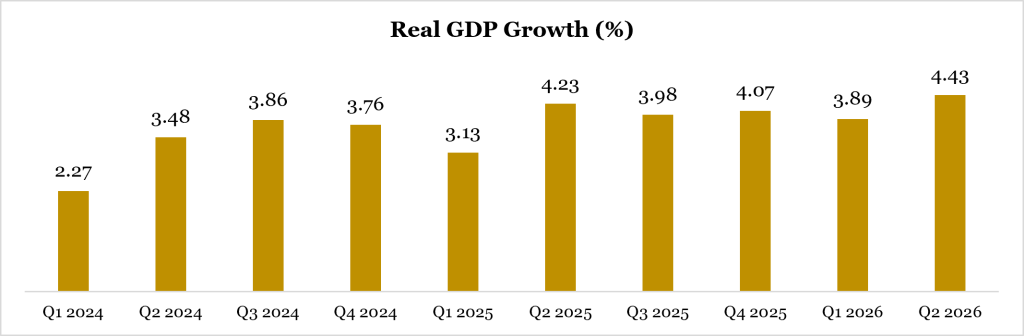
Nigeria’s real GDP growth accelerated to 4.43% year-on-year in Q2 2026 from 3.89% in Q1 2026 and 4.23% in Q2 2025, marking the strongest quarterly growth since Q2 2025. The improvement was driven by stronger performance across services and agriculture, alongside a recovery in oil output. Services remained the dominant engine of growth, accounting for 56.62% of real GDP, while agriculture also recorded stronger momentum. However, industrial growth moderated sharply to 3.96% in Q2 2026 from 7.46% in Q2 2025 (although it was slightly up compared to 3.92% in Q1 2026), indicating that persistent supply-side constraints continue to limit the scope of the recovery.
Also, while the acceleration in real GDP growth is encouraging, the gap between real and nominal activity remains a key concern. Nominal GDP increased by 18.43% y/y to ₦119.3 trillion in Q2 2026, from ₦100.73 trillion in Q2 2025, significantly outpacing real GDP growth. The divergence implies an estimated GDP deflator growth of 13.4%, indicating that a substantial portion of the increase in nominal output was driven by higher prices rather than an equivalent expansion in the volume of goods and services produced. This reinforces the view that, although economic activity is improving, price effects remain a significant component of nominal growth.
Notwithstanding, the Q2 outturn points to a gradual strengthening of economic activity. Services and agriculture are providing the strongest support, while the industrial sector continues to lag. Sustaining the recovery will therefore require a stronger expansion in productive capacity, particularly through improved infrastructure, energy supply and private-sector investment.
Oil Sector
The oil sector grew by 7.31% in Q2 2026, up from 2.57% in Q1 2026, but significantly below the 20.46% recorded in Q2 2025. The quarter-on-quarter improvement was supported primarily by higher crude oil production, which increased to 1.72mbpd from 1.55mbpd in Q1 2026.
The sector’s contribution to real GDP increased to 4.16% in Q2 2026 from 3.92% in Q1 2026 and 4.05% in Q2 2025. Despite its relatively small contribution to output, the sector remains critical to Nigeria’s fiscal and external position, with stronger oil production and prices supporting government revenue, FX liquidity and overall macroeconomic stability.
Non-Oil Sector Performance
The non-oil sector expanded by 4.31% in Q2 2026, accelerating from 3.94% in Q1 2026 and 3.64% in Q2 2025. The sector accounted for 95.84% of real GDP, slightly below 96.08% in Q1 2026 and 95.95% in Q2 2025.
The continued dominance of the non-oil sector highlights the increasing importance of domestic activity, particularly services and agriculture, in driving growth. However, the relatively modest pace of expansion also suggests that stronger productivity gains will be required to translate the sector’s broad contribution into faster and more sustainable economic growth.
Sector Breakdown
Of the 46 activities tracked by the NBS, 32 recorded q/q expansion in Q2 2026, while nine slowed and five contracted. On a y/y basis, 30 activities expanded, 11 recorded slower growth, and five contracted, indicating a broad-based improvement in economic activity despite pockets of weakness.
Agriculture accelerated to 4.39%, from 2.82% in Q2 2025, supported largely by stronger crop production, which accounts for over 50% of the sector’s nominal value.
Within industry, growth moderated to 3.96% from 7.46% in Q2 2025, largely reflecting a high base effect from the mining and quarrying subsector, which is heavily dominated by crude petroleum and natural gas. Despite the slowdown in growth, crude oil production increased to 1.72mbpd, the highest level in over four years. Other industrial activities were comparatively resilient, with construction and water supply, sewerage, and waste management recording stronger growth.
A more concerning development within industry was electricity, gas, steam and air conditioning supply, which contracted by 10.63% in real terms, reversing 11.47% growth a year earlier and marking a second consecutive quarterly decline. Weak power-sector performance remains a structural constraint, given its implications for manufacturing, ICT infrastructure and the broader cost of doing business.
Services remained the strongest component of the economy, with Information and Communication growing by 9.62%.
Outlook
The Q2 GDP data reinforce the view that Nigeria’s economic recovery is gaining traction. However, the pace and composition of growth remain important. Services and agriculture continue to provide resilience, while higher oil production is supporting the extractive sector, but industrial activity remains constrained by structural bottlenecks.
In the coming quarters, sustaining growth will depend increasingly on improvements in productive capacity and private-sector investment, rather than base effects or stronger nominal activity. Continued moderation in inflation, improved power supply, greater infrastructure investment and stronger credit transmission would be critical to strengthening manufacturing and investment activity.