Fixed Income Quarterly - Q3 2026
Macro-Economic Overview
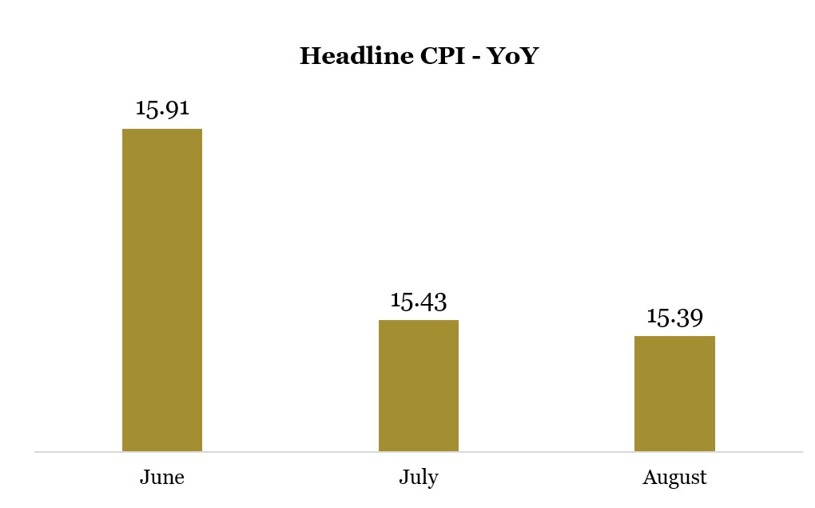
Headline inflation continued to moderate throughout Q3 2026, declining from 15.91% YoY in June to 15.43% in July and 15.39% in August. The moderation was supported by a slower pace of price increases, particularly in August, as food price pressures eased following the sharp increase recorded in July. However, food inflation remained elevated during the quarter, while transport and other service-related costs continued to contribute to headline inflation. On a month-on-month basis, inflation eased from 1.66% in June to 1.57% in July and further to 0.71% in August, indicating a notable moderation in sequential price pressures towards the end of the quarter.
At the Monetary Policy Committee (MPC) meetings held in July, the Committee maintained a tight monetary policy stance before resetting in September. At the July meeting, the MPC retained the Monetary Policy Rate (MPR) at 26.50%, while maintaining the Standing Facilities Corridor at +50/-450 basis points around the MPR. The Cash Reserve Ratio (CRR) was also retained at 45% for Deposit Money Banks, 16% for Merchant Banks, and 75% for non-TSA public sector deposits. However, at the September 21st–22nd meeting, the Committee reset the MPR to 23.00% (350bps lower) and recalibrated the Standing Facilities Corridor to +50/-300bps, while retaining the CRR at the existing levels. According to the CBN, this was an operational reset to enhance the effectiveness of monetary policy and support the transition to an inflation targeting framework.
Crude oil prices remained volatile in Q3 2026, largely driven by developments in the Middle East and disruptions to global oil supply routes. Brent crude declined to around $71.57/barrel in early July following easing Middle Eastern tensions. For most of September, we saw prices remain elevated above the $100 mark, peaking around $108.75 around mid-month as renewed attacks and disruptions around the Strait of Hormuz heightened supply concerns. Prices averaged approximately $91.29/barrel in the quarter. However, prices moderated towards end of the quarter as Middle East exports showed signs of recovery and diplomatic efforts gained traction.
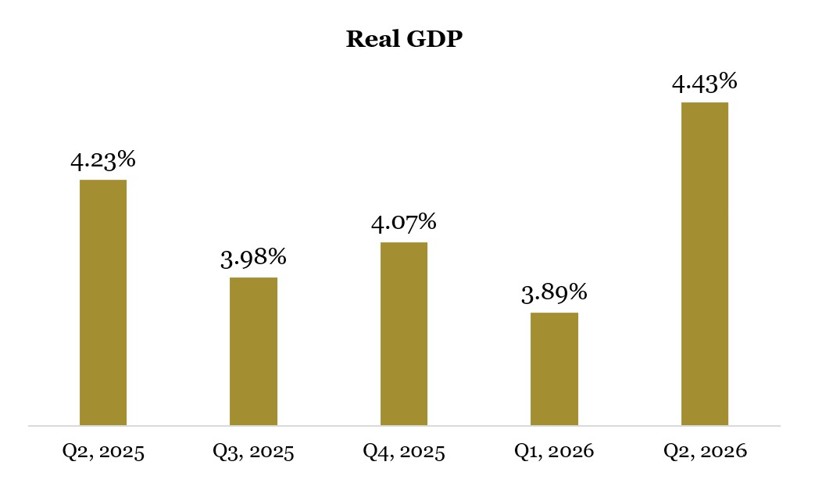
Nigeria’s Composite PMI recovered in Q3 2026, rising from 50.1 points in June to 51.1 points in July and 52.7 points in August, signaling a return to expansion after the contractions recorded in Q2. The improvement was largely driven by stronger activity in the services and agricultural sectors, while the industrial sector also returned to expansion in August.
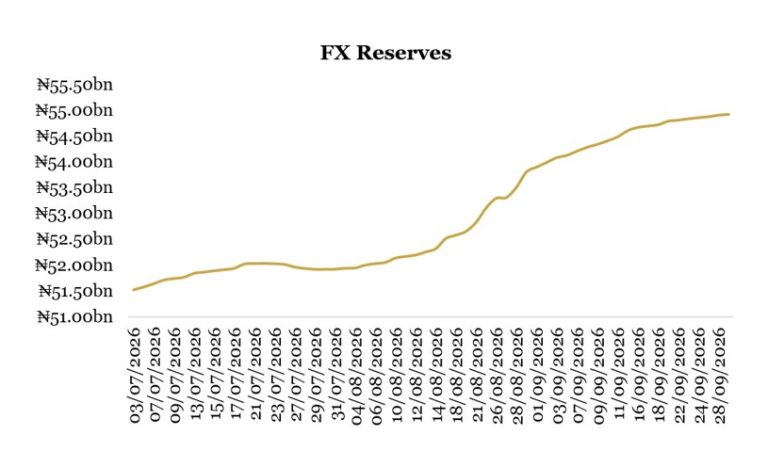
Nigeria’s gross external reserves continued to strengthen in Q3 2026, rising from $51.53bn at the start of the quarter to $54.92bn by the end of Q3, supported by stronger FX inflows, resilient FPI inflows, higher IMTO receipts and improved oil export earnings.
Interbank liquidity remained robust during the quarter, averaging approximately ₦4.40trn, from a low of ₦1.81trn in mid-July and peaking at around ₦8.84trn in late Sept.
Bond market
The FGN bond market experienced a notable shift in sentiment during the quarter as investors reassessed the outlook for interest rates, with yields trending lower across the curve amid expectations of lower government bond supply. The FGN bond market began to show signs of a bullish reversal in July, following the bearish trend witnessed towards the end of Q2. Average yields declined by c.60bps to 18.06% from 18.65% at the start of the month, with demand emerging particularly across the belly and long end of the curve as investors sought to lock in attractive yields. At the July auction, the DMO offered ₦1.20tn across the Jan-2035, Apr-2037 and Jun-2038 bonds, attracting c.₦1.74tn in subscriptions and allotting ₦931.82bn to competitive bidders at marginal rates of 18.34%, 18.35% and 18.40%, respectively. Sentiment improved further following the release of a revised Q3 issuance calendar, which indicated lower planned issuance.
The market moved sideways in August as investors consolidated positions ahead of the auction, with average benchmark yields edging down to 16.83% from 16.89%. At the auction, the DMO offered ₦1.10tn across the Jan-2035, Apr-2037 and Jun-2038 tenors, attracting ₦1.73tn in subscriptions and allotting ₦805.16bn. Stop rates declined to 17.15%, 17.19% and 17.79%, respectively, reinforcing the broader yield compression and supporting renewed buying interest in the secondary market.
In September, the DMO introduced the Sep-2036 bond at 16.79% alongside a reopening of the Jun-2038 at 16.85%, further reinforcing the downward repricing in the market. The rally accelerated following the MPC’s decision to reduce the policy rate by 350bps, triggering a broad-based repricing across the curve. The benchmark 2038 yield fell by more than 100bps in a single session to as low as 15.90%, while buying interest broadened across the 2031, 2032, 2035, 2036, 2037, 2045 and 2053 maturities. The repricing reflected investors’ adjustment to the lower-rate environment, with demand increasingly concentrated in mid- and long-dated securities as market participants sought to position for further yield compression.

Treasury bill market
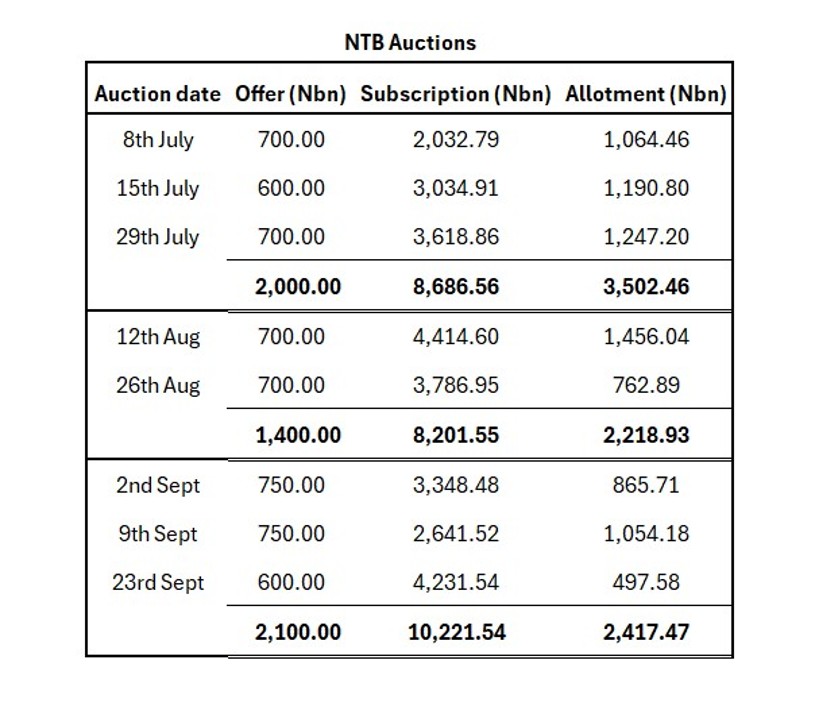
The Nigerian Treasury Bills market experienced a gradual shift in sentiment throughout Q3 2026. The quarter commenced with elevated yields and strong demand for duration, as investors sought to lock in attractive returns amid ample system liquidity, with a clear preference for the long end of the curve. Ahead of the 8-Jul primary market auction, system liquidity stood at approximately ₦4.87tn, while total subscriptions exceeded ₦2.00tn and total allotment reached ₦1.06tn, against ₦700bn offered. Strong demand was sustained at the 15-Jul and 29-Jul auctions, with the 364-day bill recording bid-to-cover ratios of 7.18x and 6.76x, respectively. The robust subscription levels provided room for long-end bills to reprice lower over the course of July. The strong demand continued into August, albeit amid mixed sentiments across the Treasury Bills space. Yields came under upward pressure, particularly across the short-to-mid end of the curve, with the Nov-26 maturity trading around 16.50%. The elevated yield environment remained attractive to institutional investors, supporting increased participation in the fixed-income market.
In mid-August, the CBN released a circular announcing revisions to the framework governing access to Open Market Operations (OMO). The development resulted in increased activity in OMO bills in the secondary market, alongside stronger participation at OMO auctions. Towards month-end, secondary-market yields recorded a notable increase across the shorter-dated maturities, with average yields rising from c.18.17% on 12-Aug to 19.10% on 24-Aug, representing a 93bps increase. In contrast, the tail end of the curve experienced a decline in yields, with the 364-day bill stop rate declining by 44bps from 17.59% to 17.15% at the 26-Aug auction. September marked a stronger bullish turn as investors positioned for a lower-rate environment. System liquidity increased to c.₦7.45tn from ₦2.86tn, while yields continued to trend lower ahead of the MPC meeting. At the MPC meeting, the committee cut the MPR by 350bps to 23.00%. At the 23-Sep auction, subscriptions rose to ₦4.23tn from ₦2.64tn previously, with the 364-day bill recording a 13.65x bid-to-cover ratio. The 364-day stop rate declined by 177bps from 17.66% in mid-July to 15.89%, bringing Q3 to a close on a strongly bullish note.
The CBN floated twelve (12) OMO auctions during the quarter, offering c. N11.90trn across the tenors. Total sales through the quarter were over c. N35.96trn. Despite the oversubscriptions recorded at the auctions, there were six (2) no sale during the auctions.
The DMO conducted eight (8) NTB auctions during the quarter with each month recording an oversubscription of N6.686trn, N6.80trn and N8.12trn respectively. In total, the DMO oversold c. N2.64trn, by allotting N8.14trn against the N 5.50trn on offer. Stop rates at the last auction of the quarter closed at 15.50%, 15.80% and 15.89% across the 91-days, 182-days and 364-days tenors respectively.
Eurobond Market
Global macro conditions became more challenging during Q3 2026, as renewed geopolitical tensions, higher energy prices and rising global bond yields weighed on emerging-market fixed income. The Federal Reserve maintained its target rate at 3.50%–3.75% in Jul before raising it by 25bps to 3.75%–4.00% in Sept, while the ECB kept rates unchanged in Jul before hiking its key rates by 25bps in Sept. Brent crude remained volatile, rising sharply during the quarter as renewed US-Iran tensions and disruptions around the Strait of Hormuz pushed prices above $100/barrel in Sept.
Global Economic & Market Backdrop
The third quarter was characterized by a shift from relatively supportive global financial conditions in Jul and Aug to renewed duration pressure in Sept. The Fed maintained rates at 3.50%–3.75% in Jul but subsequently raised the target range to 3.75%–4.00% in Sept as inflation remained elevated. The ECB, meanwhile, held rates in Jul but raised its key rates by 25bps in Sept, citing persistent inflationary pressures from the Middle East conflict.
The U.S. dollar remained relatively firm, while U.S. Treasury yields rose sharply towards quarter-end. The 10-year Treasury yield moved above 5% in Sept, increasing yield for emerging and frontier-market sovereign debt. Meanwhile, Brent crude moved above $100/barrel in Sept as renewed conflict disrupted Middle East energy flows, adding to inflation concerns and weakening the outlook for global monetary easing.
Sub-Saharan Africa Technicals
SSA Eurobonds initially benefited from improved risk appetite during Jul and Aug, with yield compression recorded across several markets. However, the sharp increase in U.S. Treasury yields and renewed geopolitical concerns triggered a broad repricing in Sept. The pressure was particularly evident in longer-duration securities, although improving domestic fundamentals provided some support.
Nigeria
Nigeria’s macro backdrop improved during Q3, supported by continued disinflation, stronger external reserves and improved FX conditions. Headline inflation moderated to 15.39% in Aug, while the CBN reduced the MPR by 350bps to 23.00% in Sept and narrowed the Standing Facilities Corridor to +50/-300bps. External reserves also rose above $54 billion during the quarter. In the Eurobond market, Nigerian securities initially benefited from improved risk sentiment and stronger domestic fundamentals. However, the curve came under pressure in Sept as global yields rose. By Sept 16, yield on NGERIA 51s was at 8.31%, up from 8.16% at Aug end, while the 49s and 46s rose to 8.22% and 8.23%, respectively. Towards the end of the quarter, renewed buying interest emerged, with Nigeria’s Eurobond market closing firmer.
Ghana
Ghana’s macroeconomic conditions continued to improve during Q3, supported by sustained disinflation, reserve accumulation and progress on its debt restructuring programme. Inflation increased modestly from 4.6% in Jul to 5.0% in Aug, while the Bank of Ghana maintained its policy rate at 14.0% throughout the quarter. The IMF’s sixth review also highlighted substantial improvements in fiscal performance and debt sustainability, with the risk of debt distress revised from high to moderate. Ghana’s restructured Eurobond curve remained relatively firm through much of the quarter, supported by improving sovereign fundamentals and declining external financing risks.
Kenya
Kenya’s macro environment remained relatively stable during Q3, supported by a stable shilling and adequate foreign-exchange reserves. Inflation rose marginally from 6.5% in Jul to 6.6% in Aug and further to 6.8% in Sept, driven mainly by food, transport and housing-related costs. The Central Bank of Kenya maintained its policy rate at 8.75% following its Aug meeting. Kenya’s Eurobonds initially benefited from improved global risk appetite in Jul and Aug, but the curve came under significant pressure in Sept as U.S. Treasury yields rose. By Sept 18, the 2032s were at 7.89%, the 2033s 8.13%, the 2034s 8.45%, while the longer-dated 2038s, 2039s and 2048s yielded 9.21%, 9.26% and 9.25%, respectively. The sell-off was more pronounced at the long end, reflecting heightened duration sensitivity to the global rates repricing.
Angola
Angola recorded one of the strongest macro improvements among the major SSA sovereigns during Q3. Inflation continued to decline, falling from 9.33% in Jul to 8.78% in Aug, its lowest level since April 2015. The BNA responded with consecutive rate cuts, reducing its policy rate by 125bps in Jul and a further 100bps in Sept to 14.75%. Stronger oil prices also supported the economy, with the BNA raising its 2026 growth forecast to 6.15%. The improved macro backdrop supported Angola’s Eurobonds during the earlier part of the quarter. The 2032s yield touched 8.16% on Aug 4, while the curve subsequently experienced some pressure as global risk-free yields rose. By Sept 30, indicative yields stood at 8.87% on the 2032s, 9.22% on the 2033s and above 10% on the 2048s and 2049s. The IMF, however, continued to highlight Angola’s dependence on oil revenues and the need to use higher oil receipts to strengthen fiscal buffers and reduce debt vulnerabilities.
Egypt
Egypt’s macroeconomic backdrop remained broadly supportive during Q3, although higher global oil prices and regional geopolitical tensions remained key risks. Urban headline inflation eased from 14.9% in Jul to 14.5% in Aug, while core inflation increased slightly to 14.9%. The Central Bank of Egypt maintained its deposit and lending rates at 19.00% and 20.00%, respectively, at its Sept meeting. Egypt’s external credit fundamentals also improved, with the IMF noting that sovereign spreads had narrowed to below pre-war levels and that the country’s sovereign risk premium had fallen to its lowest level since 2014 by Aug. However, the renewed regional tensions in Sept increased refinancing risks, with Egypt’s planned US$3 billion international borrowing programme becoming more sensitive to market conditions and higher global yields.
Q3 2026 Outlook
Local market
In Q4 2026, we expect the market to remain cautiously constructive, with yields likely to consolidate around lower levels, reflecting the more accommodative monetary policy stance and the significant repricing in Q3. Continued liquidity support should underpin demand, although profit-taking and global geopolitical disruptions could drive intermittent upward pressure on yields.
Eurobond market
Global: The Fed’s September 25bps hike and elevated inflation risks could keep global yields volatile in Q4, limiting the scope for further easing and keeping SSA spreads sensitive to U.S. rates.
Nigeria: Nigerian Eurobonds are expected to remain sensitive to geopolitical disruptions and upticks in U.S. Treasury yields in Q4, while the proposed Eurobond issuance could serve as a key market catalyst.
Ghana: With the policy rate held at 14% and inflation remaining relatively contained, further easing will depend on the inflation and cedi outlook, while improving fiscal conditions should support Eurobond valuations.
Kenya: Stable inflation and the CBR at 8.75% provide room for gradual easing, although fiscal consolidation and global rate movements will remain key drivers of Eurobond performance.
Angola: Continued disinflation and the recent policy-rate cuts provide room for further easing, while elevated oil prices should support fiscal and external buffers.
Egypt: The CBE is likely to maintain a cautious stance in Q4, with rates currently unchanged at 19.00%, as it balances continued disinflation against renewed energy-price and geopolitical risks.