Inflation Projected to Rise to 15.85% in April
The National Bureau of Statistics is scheduled to release the April 2026 Consumer Price Index (CPI) and inflation report on May 15.
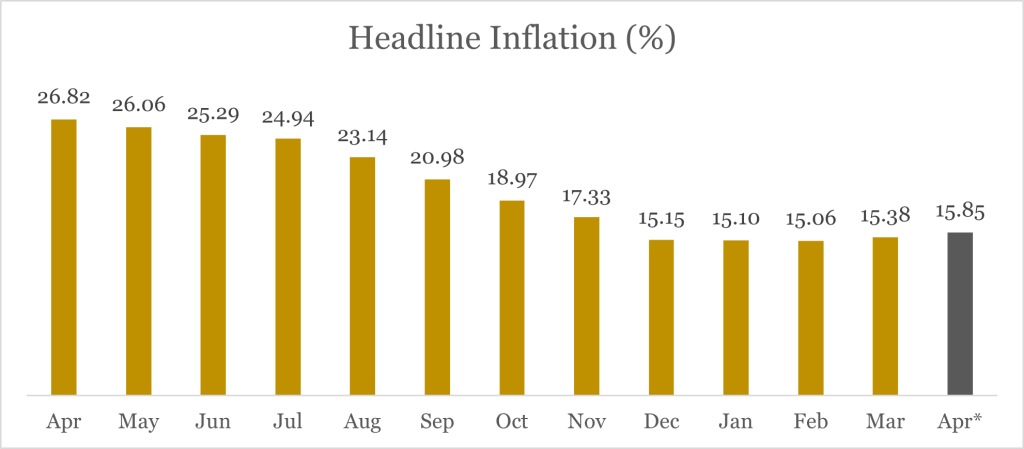
Our model projects an uptick in headline inflation to 15.85% in April from 15.38% in March. This largely reflects base effects, as current price levels are measured against a relatively low inflation base in the corresponding period last year.
In contrast, month-on-month inflation is expected to ease sharply to 2.28% from 4.18%, indicating a slowdown in the pace of price adjustments relative to March. Notably, the March spike was largely driven by the immediate pass-through from the energy shock, as PMS prices surged from below ₦900/litre to above ₦1,200/litre, representing an increase of over 20%. In April, however, price adjustments were more measured, with PMS prices rising modestly further (less than 10%) to around ₦1,300/litre, suggesting that the bulk of the initial pass-through had already been absorbed.
Hence, the moderation in monthly inflation is better interpreted as a normalization in pricing behaviour following a shock-induced repricing episode, rather than the onset of a broad-based disinflation trend.
This easing in momentum was further supported by relative stability in the foreign exchange market, with the naira appreciating by 2.01% at the official window and posting gains of 0.86% in the parallel market. This helped to soften imported inflation pressures and limited additional pass-through to domestic prices.
MPC Outlook
The Monetary Policy Committee (MPC) is set to meet next week, just days after the release of the April inflation data, making it a key input into deliberations. While month-on-month inflation is expected to moderate following the initial energy-induced shock in March, the Committee is unlikely to downplay the lingering upside risks from recent energy-related price adjustments.
Against this backdrop, we expect the Committee to adopt a cautious, wait-and-see approach, keeping policy unchanged while closely monitoring inflation dynamics, energy pass-through, and exchange rate developments.